Can you use AI images on your flyers, menus and van? What UK businesses should know
The UK government has published its report on copyright and AI. What it means for a business printing AI-made artwork, and the habits that keep you out of trouble.
· 6 min read
By the Blessed Pixels team
You made a lovely cover for the new menu in ChatGPT. Or a poster for the Christmas market, or a cartoon fox for the side of the van. Before it goes to the printer, a fair question: are you actually allowed to use it, and does anyone own it?
For most everyday business use, the practical answer is that you can use it, with some care. Who owns it is a much less settled question, and the UK government's new Report on Copyright and Artificial Intelligence hasn't settled it either. This post explains where things stand in plain terms and what to do before you print. It's general information, not legal advice. If a lot of money rides on one image, such as a logo you plan to build a brand around, talk to a solicitor or a trade mark attorney.
What the government's report says, briefly
The report follows the consultation the government ran on copyright and AI. Two parts of it matter to a business printing AI artwork.
The first is about how AI tools are trained. Law firms summarising the report describe the government as backing away from a new exception that would have let AI companies train on copyrighted work freely, and keeping the current position for now while it watches what happens. That's mostly a fight between AI companies and creative industries. It doesn't change what you're allowed to print this week.
The second is closer to home. UK law has an unusual rule for "computer-generated works", which can give a kind of copyright to a work with no human author. Law firm VWV's summary is titled the end of copyright for computer-generated works, which tells you the direction of travel. A report isn't a new law, though. Any change would need legislation, and the details could shift on the way.
For you, that adds up to something simple. Don't assume you'll own copyright in an image an AI tool made for you. We say the same thing in our print artwork terms: we can't promise you own copyright in an AI image, and we claim no rights in the files we make for you.
Using an image and owning it are different things
People often treat these as the same question. They aren't.
Using an image means printing it on your flyers, menus and banners. For that, two things matter: what the AI tool's own terms allow, and whether the image copies something that belongs to someone else. Most of the big tools let you use what you make for business, but terms differ between tools and between free and paid plans, and they change. Read the current terms of the tool you used, and save a copy with the date.
Owning it means being able to stop other people using it. If copyright doesn't protect your image, a competitor who copies your poster might be hard to stop on copyright grounds. For a one-off event flyer, that barely matters. For a mascot that will sit on your van, your cups and your website for ten years, it matters a lot more.
If you're making something for a single print run, the usual worry is quality, not law. We covered that in how big you can print an AI image, and our print-ready packages deal with the sharpness, bleed and colour side.
The risk that matters most: copying by accident
Ownership is the slow, uncertain problem. The faster one is an AI image that looks too much like something that already exists.
AI tools learned from millions of pictures, and when you ask for something specific they can produce work that's close to a real character, a real brand or a real person. Printing that on 1,000 flyers is where a business can get a letter it doesn't want.
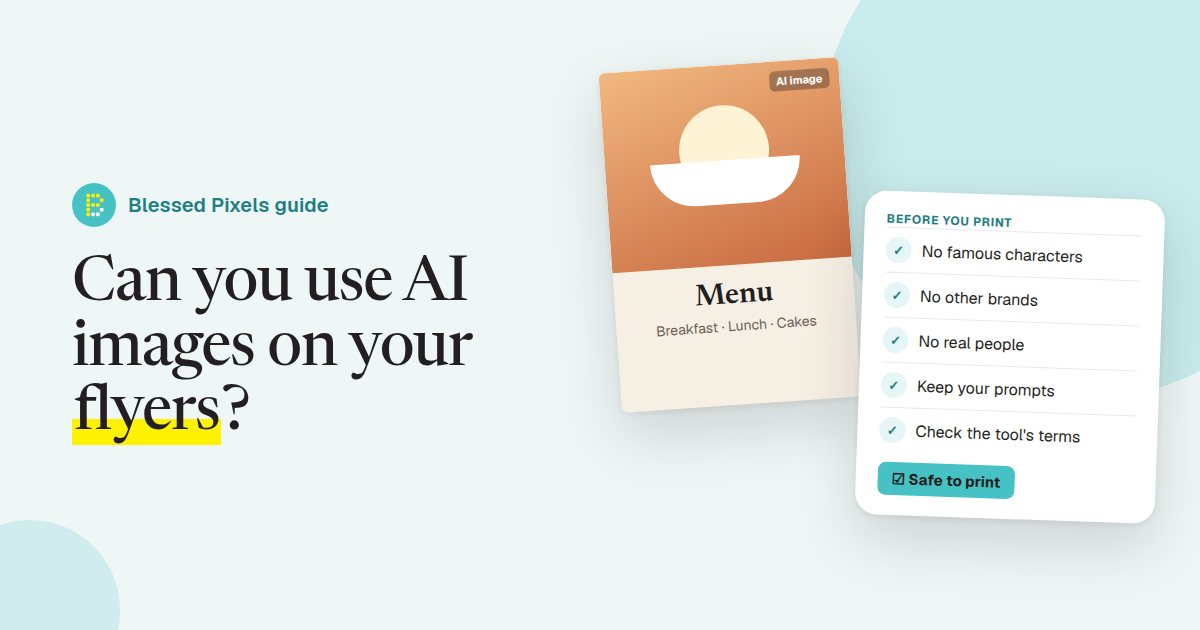
A few prompts to steer clear of:
- "In the style of" a named living illustrator or studio. Style on its own is murky legal ground, but a near-copy of a famous artist's look invites a complaint even when you'd win the argument.
- Famous characters, even "a bit like" them. A friendly mouse in red shorts is still that mouse.
- Other companies' logos, packaging or shop fronts in the background.
- Real, recognisable people, including celebrities and your local MP. Using a real person to promote your business without their permission can cause trouble well beyond copyright.
- Text and slogans the tool makes up, which sometimes turn out to be someone's trade mark.
Look at the finished image with a stranger's eyes. Does anything in it remind you of a brand or a character you've seen before? If you hesitate, change it. Our list of what usually goes wrong with AI artwork is mostly about print problems, but garbled lettering is on it, and replacing made-up text with real type also removes accidental slogans.
A record-keeping habit that costs nothing
If anyone ever questions an image, the business that can show how it was made is in a far better position than the one that can't.
Keep a simple folder for each design with:
- The prompts you typed, copied as text, with the date.
- The name of the AI tool and which plan you were on.
- A saved copy of the tool's terms on that date.
- Each version you generated, not just the final one.
- Anything you changed by hand afterwards: new text, a different colour, an extra element.
That last one is worth doing anyway. The more human choices go into a design, the more there is that's clearly yours. A café owner who takes an AI background, then writes the menu, picks the fonts and arranges the dishes has made something with a lot of their own work in it.
When you send artwork to us, the same thinking applies. Our terms ask that you own the image or have permission to use it, and the questions on our print page cover what we can and can't take on.
Logos and mascots: think about a trade mark
One option often gets forgotten. A trade mark protects a sign that identifies your business, such as a name, a logo or a mascot, when it's used for your goods or services. Registering one in the UK doesn't depend on who owns copyright in the drawing.
So if an AI-assisted logo is going to be the face of your business, registering it as a trade mark can give you protection that copyright might not. GOV.UK explains how to register a trade mark, including the fees and the checks you should run first to make sure nobody else has something too similar.
Many businesses go one step further and have a designer redraw an AI sketch as a clean logo. You end up with a vector file that prints at any size, plus a design with plenty of human work in it. Turning an AI image into a clean, print-ready file is the job of our Fix and print and Business pack options.
Frequently asked questions
Can I legally print an AI image on my business flyers?
Usually, yes, if the AI tool's terms allow business use and the image doesn't copy someone else's character, brand, artwork or likeness. Check the tool's current terms and look at the image carefully before printing.
Do I own the copyright in an image ChatGPT made for me?
Nobody can promise that under current UK law. The rules on computer-generated works are under review, and the government's report points towards change. Treat ownership as uncertain and protect important designs another way, such as a trade mark.
What does the UK copyright and AI report change right now?
Nothing you print this week. It sets out the government's position and possible future changes. New rules would need legislation first.
Can I put a celebrity or a famous character in an AI image for my business?
Don't. Even if the AI tool will make it, using a recognisable person or a well-known character to promote your business without permission can lead to complaints and legal claims.
Should I register my AI-made logo as a trade mark?
If it will represent your business for years, it's worth considering. A trade mark doesn't depend on who owns copyright in the drawing. Search for similar marks first, and get advice if the stakes are high.