ChatGPT ads are now in 89 countries. Pay for the ad, or earn the answer?
OpenAI has taken ChatGPT ads to 26 more countries. What that means for a business, and why the free answer above the ad still deserves your attention first.
· 5 min read
By the Blessed Pixels team
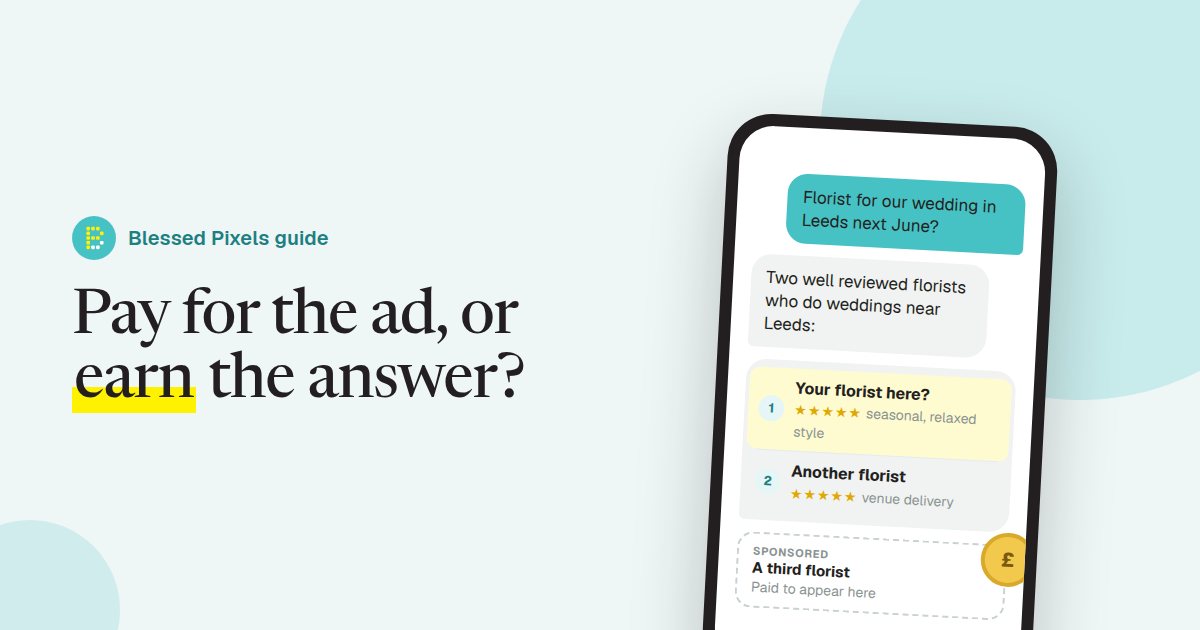
A couple in Leeds ask ChatGPT for a florist who can do their wedding flowers next June. ChatGPT answers with two florists and why it picked them. Underneath, in a separate box marked as sponsored, a third florist has paid to appear.
That picture is now possible in a lot more places. OpenAI announced that ChatGPT ads have expanded to 26 new countries, taking them to 89 markets, and said more than 100,000 advertisers have used the platform. If you run a business, you'll probably hear from someone offering to "get you into ChatGPT" with ads before Christmas.
So it's worth being clear about what an ad there buys you and what it doesn't, and where most businesses should start.
Two ways to show up in a ChatGPT answer
There are now two separate routes.
The first is the answer itself. When someone asks for a recommendation, ChatGPT pulls together what it can find and know about businesses that fit, and names some of them. Nobody pays for that. You get in by being easy to find, easy to understand and well reviewed.
The second is the ad. It sits apart from the answer and is labelled. OpenAI has said from the start that ads are kept separate from answers and don't change what ChatGPT recommends; news coverage when ChatGPT started showing adverts explained how it works for users.
That separation is the important bit. Paying for an ad doesn't make ChatGPT say nice things about you in the answer, and not paying doesn't keep you out. The two run side by side. Our full AI audit is about the first route, the one you can't buy.
What an ad can do for you
Ads aren't a bad idea. They can make sense when:
- You sell something people ask about in a buying mood, such as a product, a booking or a quote.
- You already show up in the answer and want more visibility for a launch or a busy season.
- You have a budget to test, a way to track enquiries, and the patience to compare the results against what you already spend on Google or social ads.
Treat it like any new ad platform. Start small, set a clear limit, and measure enquiries rather than clicks. If whoever is selling you the ads can't tell you how you'll measure results, wait.
Before spending anything, run our free AI check. If AI tools can't read your website properly, an ad sends people to a page that doesn't help them decide either.
Why the free answer still matters more
An ad stops when the money stops. A place in the answer keeps working while you sleep, in every country where people ask about the kind of business you run.
It's also where trust sits. People tend to read the answer as advice and the box below it as advertising, much as many people treat the sponsored results on Google. A florist named in the answer with a line like "well reviewed for relaxed, seasonal wedding flowers" is in a stronger spot than the same florist in an ad.
And the answer is shaped by things you control. In our audits we look at the areas that feed it, listed on what we audit:
- Whether AI crawlers are allowed to read your website at all.
- Whether your services, prices, opening hours and the places you cover are written as plain text.
- Whether your business details match across your website, Google Business Profile and directories.
- Whether your reviews describe what you're good at.
- Whether structured data tells machines the same facts your pages tell people.
None of those cost anything to keep on top of except time.
The answer isn't only in ChatGPT
Google is changing its own AI results too. It recently announced updates to AI Mode and AI Overviews to help people explore the web, with more ways to reach websites from those answers. Gemini, Copilot and Perplexity all build answers in similar ways.
That's good news for anyone who works on the basics, because the same work helps everywhere. A clear page about your wedding flowers, with your prices, the venues you deliver to and how far ahead people should book, can be picked up by all of them. An ad on one platform only helps on that platform.
If you'd like a list of exactly what to change on your own site, our team can make the fixes after the audit, or you can hand the report to whoever looks after your website.
A sensible order for the next three months
You don't need to choose forever. A practical order:
- This week: ask ChatGPT, Gemini and Google's AI Mode the question a new customer would ask, in their words, with your town. Write down who gets named and what's said about them. That's your starting point.
- This month: fix the obvious gaps. Hours, services, prices, areas, matching details. Ask a few happy customers for reviews that say what you did for them.
- Next month: ask the same questions again and compare.
- Then, if you want more, test a small ad budget, and judge it against real enquiries.
If step one is the part you'd rather not do alone, a 30-minute expert call is a quick way to go through the results with someone who knows what to look for.
Frequently asked questions
Can I pay to be recommended by ChatGPT?
You can pay for an ad, which appears separately and is labelled. OpenAI says ads don't influence the answer itself, so you can't pay to be recommended in it.
Are ChatGPT ads available in my country?
They're now in 89 markets after the latest expansion. Check OpenAI's announcement for the current list, since it's still growing.
Will ChatGPT ads replace Google Ads for my business?
Not on current evidence. They're a new channel to test alongside what already works for you, not a straight swap.
How do I get into ChatGPT's answers without paying?
Make your services, prices, hours and areas clear in plain text on your website, keep your details the same everywhere, let AI crawlers in, and build genuine reviews. Nobody can guarantee a mention, but these give you the best chance.
Do ads in ChatGPT show up for every question?
No. Ads appear alongside some answers, not all of them, and they're always marked so you can tell them apart from the answer.